

JAPAN IN FULL BLOOM
- calendar_today 28 Mar 2027
- bedtime 24 nights
- directions_boat Sapphire Princess
- location_on Depart from Tokyo

- Inside price from $5,499*/person
- Outside price from $6,649*/person
- Balcony price from $9,549*/person
- Suite price from $11,699*/person

Earn & redeem points on all travel* with World360 Rewards – join free today!
Set sail on Sapphire Princess for an extraordinary 24 night cruise and stay holiday from Tokyo, tracing Japan’s most breathtaking coastlines just as the nation bursts into its iconic cherry blossom season.
Departing Tokyo as the blossoms reach peak bloom, Sapphire Princess traces the Pacific coast south through Kochi and Kagoshima before crossing to Busan and threading the historic Kanmon Straits to Hiroshima. Then north along the Sea of Japan, the coast most Japan travellers never reach, calling at Hakodate’s legendary morning fish market, Kanazawa’s Edo-era streets and Kenrokuen Garden, and Nagasaki’s layered, quietly moving history. The voyage closes at Shimizu with Mount Fuji on the horizon before returning to Tokyo.
DREAM BIGGER – ALL SAILINGS COME WITH FLEXIBLE BOOKING OPTIONS.
Your Cruiseabout specialist will walk you through the deposit flexibility on this deal and find the right fare for your situation. Expert advice included.
INCLUDED IN YOUR PACKAGE
-
Exclusive savings up to $4,200 per stateroom included
-
1 night, 4 star hotel stay in Tokyo
-
Private Transfer Tokyo Hotel to Port
-
23 night cruise on Sapphire Princess Tokyo return
-
Onboard dining across a range of complimentary venues
-
Onboard entertainment including live music & performances
-
Port charges and government fees onboard
-
Upgrade to Princess Plus to include the Plus Beverage Package, Wi-Fi for 1 device and more from $79 per person, per day
-
Upgrade to Princess Premier to include the Premier Beverage Package, Wi-Fi for 4 devices, unlimited specialty dining and more from $129 per person, per day
YOUR ITINERARY
Welcome to Tokyo. You have 1 night to explore the city.
...Toba, located at the northeastern end of the Shima-hanto Peninsula in Mie, flourished as the castle town of the Kuki family who ruled this region from the 16th century. It was also a landing spot for visitors on the sea route to Ise-jingu Shrine and belongs to Ise-Shima National Park.
...Wakayama is a Japanese prefecture in the Kansai region, on Honshū island’s Kii Peninsula. Its namesake capital is home to Wakayama Castle, an Edo-period replica set in a hilltop park with city views. Pilgrimage routes connect a trio of Shinto shrines collectively known as Kumano Sanzan.
...Kochi sits on the broad alluvial plain facing Urado Bay. This city in Shikoku takes its name from the great feudal castle that sits at its very heart. Completed in 1611, Kochi Castle was the seat of Yamauchi Kazutoyo, a noted warrior who supported Tokugawa Ieyasu in his successful quest to become Shogun. Tosa Province and Kochi Castle were Yamauchi’s reward for faithful service. There is an historical irony here: 250 years later, a Kochi native son – a former low-ranked samurai and now ronin named Sakamoto Ryoma – played a pivotal role in bringing the Tokugawa Shogunate to an end and restoring the Emperor of Japan to political prominence. The prize once awarded for faithful service had become a hotbed of support for the Meiji Restoration.
Kochi is one of the wettest places in Japan – and a frequent target for cyclonic storms or typhoons. Southeast of the city, warm oceans currents washing against the Aki Mountains create a subtropical landscape of hibiscus, palm and ficus at Muroto-Anan Quasi-National Park.
...From the 12th century to the Meiji Restoration of 1868, Kagoshima was the chief stronghold of the mighty Shimazu clan. The city lies at the top of the Satsuma Peninsula, a mountainous, geothermal wonderland of hot springs and geysers. The area is also rich in modern Japanese history: Saigo Takamori and the Satsuma samurai were leaders of the Meiji Restoration that toppled the shogun and restored the Emperor to power in 1868. In 1877, dissatisfied with the direction of the new government, Saigo led the Satsuma Rebellion, which ended in his death and the final defeat of the samurai.
The symbol of Kagoshima is Sakura Jima – the volcanic island that sits just offshore. The volcano has erupted over 30 times in recorded history.
...Yatsushiro city was developed around a beautiful Shinto shrine, built during the Heian era (794–1185). Situated along the delta of the Kuma River, facing Yatsushiro Bay, this castle town and its ruins still showcase the spirit of the city. A visit to the ruins of Yatsushiro Castle (now part of a Shinto shrine) is a good place to begin your day. Another fun and scenic landmark is the flight of 777 stairs cut into the nearby mountains. Visitors are rewarded with panoramic views from the top – there are benches to rest on along the way! Yatsushiro is famous for its 16th century pottery designed with a distinctive blue-gray crackled glaze with white inlay. Craft enthusiast and collectors can visit three Kodayaki kilns in the area. Shopping enthusiasts will also enjoy the honmachi, a covered arcade that runs the length of several city blocks, and adventurous foodies can partake in some of the city’s most exotic local fare, including Basashi, raw horse meat served with soy and garlic, a delicacy of the area. For those with a more traditional palate, the light green Rush ice cream is a treat, as is the banpeiyu fruit, the largest citrus fruit in Japan which is in season from December to January.
...The second largest city in South Korea, Busan is your gateway to a fascinating land whose culture is a unique amalgam of old and new. Modern high-rise towers dwarf ancient Buddhist temples. The city’s bustling business district offers a stark contrast to the serene grounds of Yongdusan Park. In short, Busan is a microcosm of South Korea, a nation whose startling economic success often obscures one of Asia’s most sophisticated and venerable cultures.
Busan was the scene of bitter fighting during the Korean War. The United Nations Memorial Cemetery marks the final resting place for the troops from 16 nations who gave their lives during the conflict.
...On August 6, 1945, human history was irrevocably altered when the American bomber Enola Gay dropped an atomic bomb on Hiroshima. The bomb was code-named “Little Boy,” but its detonation left half the city in ruins and aflame. Today, Hiroshima is a monument not only to the destructive forces harnessed by men but also to the indomitable will of the human spirit to overcome tragedy. At the heart of the city lies Peace Memorial Park and the Atomic Bomb Dome. The gutted walls of the city’s old Industry Promotion Hall and the skeletal frame that supported its copper dome, vaporized in the blast, are instantly recognizable symbols of Hiroshima.
Travelers to Hiroshima will discover a more serene note at nearby Miyajima Island. One of the top-three scenic spots of Japan, the island is home to ancient Itsukushima Shrine, a designated National Treasure.
...A pretty prefecture located on the northeastern coast of Honshu, Japan’s main island, Miyako, Iwate, is situated along the Pacific coast surrounded by stunning scenery of Sanriku Fukko National Park and a sandy coastline defined by dramatic rock formations carved by the pounding surf. This iconic landscape invokes images of the ‘Pure Land,’ a Buddhist concept of paradise, and is best appreciated from the deck of a cruise boat on the waters of Jodogahama. The city’s natural wonders are woven within its cultural highlights, and a visit to Kamaishi Daikannon Statue, a towering statue of the Buddhist ‘Goddess of Mercy,’ showcases sparkling Kamaishi Bay, while the historic Rokando Cave, is home to “the waterfall of the heavenly cave,” an underground cascade. No visit to Miyako’s shores would be complete without paying reverence to the tragedy that occurred on March 11, 2011, when a powerful earthquake triggered a devastating 17-meterhigh tsunami. The Taro Kanko Hotel Tsunami Remains is a testament to the power of the community’s resiliency and serves as commemorative site, an important destination for those lucky enough to visit the island as it blooms with renewal.
...It took Commodore Perry and American gunboat diplomacy to open Japan to the outside world after two centuries of self-imposed isolation. In 1859, the port of Hakodate became the first Japanese city fully opened to Westerners under the Treaty of Amity and Commerce. Foreigners soon flocked to Hakodate, and today visitors wandering the cobblestone streets of the city’s Motomachi District can view their Western-style frame houses. Hakodate, once a fishing port famed for its high quality fish and shellfish, quickly became Hokkaido’s largest city and one of Japan’s most important ports. The Great Hakodate Fire of 1934 dealt the city a near fatal blow – a blow from which Hakodate was slow to recover. Today the city is Hokkaido’s third largest – surpassed by Sapporo and Asahikawa – but retains its foremost position as the finest Japanese producer of sushi’s raw product: the high quality seafood caught in Hokkaido’s cold waters.
It may not compare to Tokyo’s Tsukiji’s Fish Market, but at Hakodate’s four-block-long Morning Market, vendors offer a stunning array of fresh fish and shellfish prized for sushi including salmon roe, sea urchin, scallops and crab. Restaurants and food stands prepare a wide arrange of dishes including domburi topped with fresh seafood.
...The capital of the Aomori Prefecture in northern Japan, Aomori derives much of its beauty from the apple orchards and cherry blossoms that encompass its landscape and the snow-covered Hakkoda Mountains that look on from a distance. Throughout its history, the city has been stricken with misfortune time and time again – in 1910, a fire destroyed Aomori, and during World War II, the city was left in ruins following an air raid – yet it always prevails.
Aomori is cherished by many who believe a local legend that the grave of Jesus Christ lies within the southern part of Aomori prefecture. However, Aomori is perhaps best known for its renowned Nebuta Festival, an elaborate yearly event in which participants illuminate giant paper representations of samurai warriors, animals, and popular cartoon characters while parading them through the streets.
...There is a celebratory air in Akita, where year round festivals and street parades are colorfully integrated into daily life. A key city in the Tohoku region since medieval times, Akita was once a castle town of the Satake clan, but today is a vibrant, prosperous city that seamlessly honors its past but embraces its young energetic spirit. Noted for its burgeoning art community, there are several fine museums to explore including The Hirano Masakichi Art Musuem housing a collection of work by Western and Japanese artists, the Akita City Folklore Museum and the Kakunodate Samurai District, a living museum that showcases the samurai way of life. In the neighboring Oga Peninsula, the region’s most famous icon, the terrifying Namahage, has it’s won cultural center and festival ritual performed in his name. Surrounding the city, fertile farmland and rice fields produce some of the best sake in the country and nature lovers won’t know which way to turn – to the west is the picturesque Sea of Japan and to the north, south and east, majestic mountain ranges including the UNESCO World Heritage sight of Shirakami-Sanchi proudly stand. A trip to the revolving observation center Mt. Kanpuzan Observatory solves the dilemma.
...Traditionally famous for rice making and sake production, Niigata is the place for gourmet aficionados. It is also well known for the seafood caught from the Sea of Japan. With this variety of the commodity produced locally, Niigata developed from the wealth gained through shipping and trade by Kitamae-bune, which were cargo ships operated along the Sea of Japan between Hokkaido and Osaka from mid-18th century to the end of the 19th century.
To the south of Niigata is the Tsubame-Sanjo area famous today for metalworking. This derives from the production of Japanese nails used for Japanese traditional architecture. To discover Japanese craftsmanship, you will have the chance to visit the Suwada Open Factory. Also nearby is the religious center of Niigata in Yahiko. The Yahiko Shrine has gathered the devotion of the locals for more than a millennium.
Kanazawa is the capital of Ishikawa Prefecture, on Japan’s central Honshu Island. It’s known for well-preserved Edo-era districts, art museums and regional handicrafts. Kenrokuen Garden, begun in the 17th century, is celebrated for its classic landscape designs incorporating ponds and streams.
...Wedged between sea, sky and mountains, this small fishing port has been esteemed for centuries for its superb seafood. Here, the Sea of Japan yields up both crab and hon-maguro, the prized Bluefin tuna esteemed by gourmets around the world. Sakaiminato is also your gateway to a very ancient region of Honshu. West of the city lies Izumo-taisha, one of the oldest and holiest shrines in Shinto. This area is dotted with burial mounds from Japan’s Bronze Age. The town of Matsue boasts the celebrated “Black Castle,” a six-story, black-walled castle that home to a clan of the mighty Tokugawa dynasty that ruled Japan for over 250 years. And to the east rises the great snow-capped summit of Mt. Daisen, considered one of the four most scenic mountains in all Japan.
...The second largest city in South Korea, Busan is your gateway to a fascinating land whose culture is a unique amalgam of old and new. Modern high-rise towers dwarf ancient Buddhist temples. The city’s bustling business district offers a stark contrast to the serene grounds of Yongdusan Park. In short, Busan is a microcosm of South Korea, a nation whose startling economic success often obscures one of Asia’s most sophisticated and venerable cultures.
Busan was the scene of bitter fighting during the Korean War. The United Nations Memorial Cemetery marks the final resting place for the troops from 16 nations who gave their lives during the conflict.
...For most travelers, Nagasaki is a symbol of the horror and the inhumanity of war. An estimated 75,000 people perished in 1945 when the city became the second target of a nuclear attack. Today, Nagasaki’s Peace Park and Atomic Bomb Museum draw visitors from around the world.
But this beautiful city on Kyushu offers other sights. Often described as the San Francisco of Japan, the city occupies verdant hills surrounded by a deep-water bay. For three centuries, Nagasaki was Japan’s sole window on the world. The city is also celebrated as the setting for Puccini’s opera “Madame Butterfly.”
...A mesmerizing landscape, a revered cultural history, and Japan’s most sacred volcano are just a few of the many delights beckoning you to come and explore this ancient city. While Shimizu may have the reputation as being bustling and modern, its cultural and spiritual side is on display in the form of ancient and enthralling shrines. Of course, it may be the sacred and snow-capped Mount Fuji that garners the most attention. Towering over the region at approximately 12,388 feet above sea level, the active volcano, designated a “place and source of artistic inspiration” by UNESCO is just one of the many unforgettable adventures Shimizu inspires.
...Your holiday comes to an end today. Interested in extending you stay? Ask us about our amazing range of packages available or speak with a Cruise Travel Advisor who will be able to customise your holiday with you.
...YOUR SHIP - The Sapphire Princess
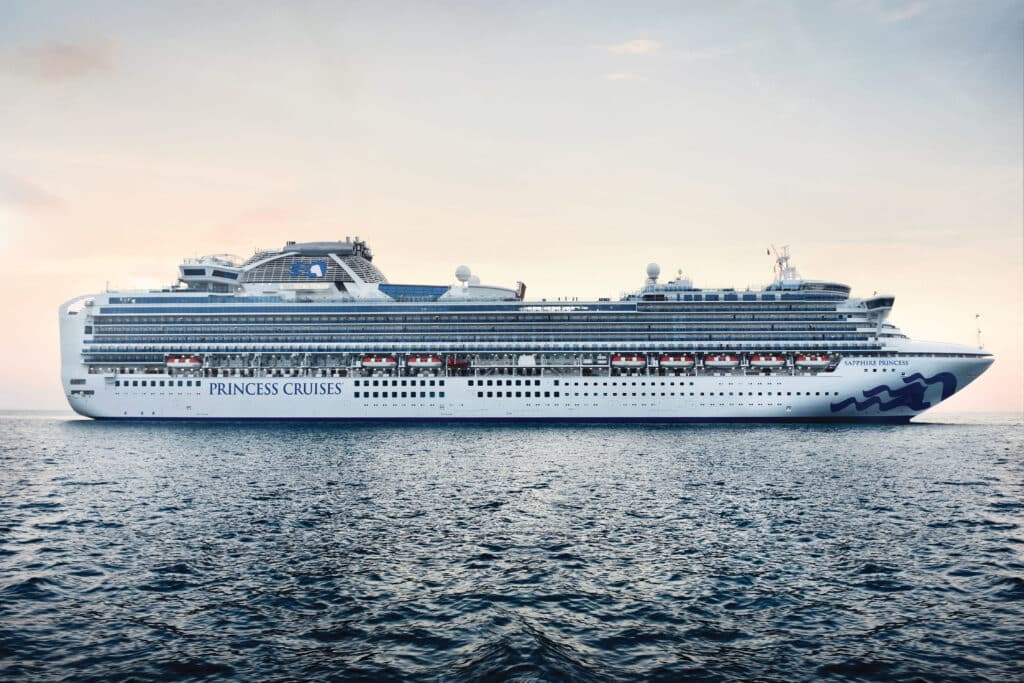
As you set your sights on the wonders of the world, let Sapphire Princess indulge your every whim. Over 700 balconies, world-class gourmet dining and dazzling entertainment options are just the beginning of your sea-going adventure. Dance the night away, enjoy casino gaming or relax and rejuvenate body and mind at the Lotus Spa.
Fitness Center
Jogging Track
Ocean View Gymnasium
Sports Court
24-hour Room Service
Churchill Lounge
Crooners Bar
Fabio’s
Hamburger Grill
Horizon Court
Ice Cream Bar
International Dining Room
Pacific Moon Dining Room
Patisserie
Sabatini’s Italian restaurant
Santa Fe Dining Room
Savoy Dining Room
Sports Bar
Sterling Steakhouse
Trident Grill
Ultimate Balcony Dining
Vivaldi Dining Room
Wake View Bar
Wheelhouse Bar
Wine bar
Club Fusion
Explorers Lounge
Night Club
Princess Theatre
Show Lounges
Skywalkers Nightclub
9-hole Mini Golf
Card Room
Cyber Golf
Golf Simulator
Kids Club
Library
Shuffle Board
Skywalkers NightClub
Swim-against-the-current lap pool
Art Gallery
Atrium
Duty-free shop
Guest Relations Office
ScholarShip@Sea
Wedding Chapel
Writing Room
Churchill Lounge
Lotus Spa
Description
As you set your sights on the wonders of the world, let Sapphire Princess indulge your every whim. Over 700 balconies, world-class gourmet dining and dazzling entertainment options are just the beginning of your sea-going adventure. Dance the night away, enjoy casino gaming or relax and rejuvenate body and mind at the Lotus Spa.
Fitness
Fitness Center
Jogging Track
Ocean View Gymnasium
Sports Court
Food and Drink
24-hour Room Service
Churchill Lounge
Crooners Bar
Fabio’s
Hamburger Grill
Horizon Court
Ice Cream Bar
International Dining Room
Pacific Moon Dining Room
Patisserie
Sabatini’s Italian restaurant
Santa Fe Dining Room
Savoy Dining Room
Sports Bar
Sterling Steakhouse
Trident Grill
Ultimate Balcony Dining
Vivaldi Dining Room
Wake View Bar
Wheelhouse Bar
Wine bar
Entertainment
Club Fusion
Explorers Lounge
Night Club
Princess Theatre
Show Lounges
Skywalkers Nightclub
Recreational
9-hole Mini Golf
Card Room
Cyber Golf
Golf Simulator
Kids Club
Library
Shuffle Board
Skywalkers NightClub
Swim-against-the-current lap pool
Other
Art Gallery
Atrium
Duty-free shop
Guest Relations Office
ScholarShip@Sea
Wedding Chapel
Writing Room
Relaxation
Churchill Lounge
Lotus Spa

Launched
2004

Tonnage
115,875
Length
952

Capacity
2,670
AVAILABLE STATEROOMS
Click the tabs to view the different staterooms with their category
![Interior Two Lower Beds-[IF]](https://www.cruiseabout.com.au/volume/images/original/1665737629.png)
Interior Two Lower Beds-[IF]
![Oceanview Two Lower Beds (Obstructed View)-[OZ]](https://www.cruiseabout.com.au/volume/images/original/1665737792.png)
Oceanview Two Lower Beds (Obstructed View)-[OZ]
![Balcony Two Lower Beds-[BF]](https://www.cruiseabout.com.au/volume/images/original/1597418846.png)
Balcony Two Lower Beds-[BF]
![Mini Suite with Balcony-[ME]](https://www.cruiseabout.com.au/volume/images/original/1665738038.png)
Mini Suite with Balcony-[ME]
Inside from $5,499*
![Interior Two Lower Beds-[IA]](https://www.cruiseabout.com.au/volume/images/original/1665737599.png)
Interior Two Lower Beds-[IA]
![Interior Two Lower Beds-[IB]](https://www.cruiseabout.com.au/volume/images/original/1665737604.png)
Interior Two Lower Beds-[IB]
![Interior Two Lower Beds-[IC]](https://www.cruiseabout.com.au/volume/images/original/1665737614.png)
Interior Two Lower Beds-[IC]
![Interior Two Lower Beds-[ID]](https://www.cruiseabout.com.au/volume/images/original/1665737618.png)
Interior Two Lower Beds-[ID]
![Interior Two Lower Beds-[IE]](https://www.cruiseabout.com.au/volume/images/original/1665737624.png)
Interior Two Lower Beds-[IE]
Interior Two Lower Beds-[IF]
Outside from $6,649*
![Premium Oceanview Two Lower Beds-[O5]](https://www.cruiseabout.com.au/volume/images/original/1665738646.png)
Premium Oceanview Two Lower Beds-[O5]
![Oceanview Two Lower Beds-[OC]](https://www.cruiseabout.com.au/volume/images/original/1665739320.png)
Oceanview Two Lower Beds-[OC]
![Oceanview Two Lower Beds-[OF]](https://www.cruiseabout.com.au/volume/images/original/1665739324.png)
Oceanview Two Lower Beds-[OF]
![Oceanview Two Lower Beds (Obstructed View)-[OV]](https://www.cruiseabout.com.au/volume/images/original/1665737770.png)
Oceanview Two Lower Beds (Obstructed View)-[OV]
![Oceanview Two Lower Beds (Obstructed View)-[OW]](https://www.cruiseabout.com.au/volume/images/original/1665737783.png)
Oceanview Two Lower Beds (Obstructed View)-[OW]
![Oceanview Two Lower Beds (Obstructed View)-[OY]](https://www.cruiseabout.com.au/volume/images/original/1665737788.png)
Oceanview Two Lower Beds (Obstructed View)-[OY]
Oceanview Two Lower Beds (Obstructed View)-[OZ]
Balcony from $9,549*
![Premium Balcony Two Lower Beds-[B2]](https://www.cruiseabout.com.au/volume/images/original/1665737913.png)
Premium Balcony Two Lower Beds-[B2]
![Premium Balcony Two Lower Beds-[B4]](https://www.cruiseabout.com.au/volume/images/original/1665737919.png)
Premium Balcony Two Lower Beds-[B4]
![Balcony Two Lower Beds-[BA]](https://www.cruiseabout.com.au/volume/images/original/1597418821.png)
Balcony Two Lower Beds-[BA]
![Balcony Two Lower Beds-[BB]](https://www.cruiseabout.com.au/volume/images/original/1597418826.png)
Balcony Two Lower Beds-[BB]
![Balcony Two Lower Beds-[BC]](https://www.cruiseabout.com.au/volume/images/original/1597418831.png)
Balcony Two Lower Beds-[BC]
![Balcony Two Lower Beds-[BD]](https://www.cruiseabout.com.au/volume/images/original/1597418836.png)
Balcony Two Lower Beds-[BD]
![Balcony Two Lower Beds-[BE]](https://www.cruiseabout.com.au/volume/images/original/1597418841.png)
Balcony Two Lower Beds-[BE]
Balcony Two Lower Beds-[BF]
Suite from $11,699*
![Club Class Mini-Suite-[M1]](https://www.cruiseabout.com.au/volume/images/original/1665738238.png)
Club Class Mini-Suite-[M1]
![Mini Suite with Balcony-[MB]](https://www.cruiseabout.com.au/volume/images/original/1665738029.png)
Mini Suite with Balcony-[MB]
![Mini Suite with Balcony-[MD]](https://www.cruiseabout.com.au/volume/images/original/1665738034.png)
Mini Suite with Balcony-[MD]
Mini Suite with Balcony-[ME]
![Grand Suite with Balcony-[S1]](https://www.cruiseabout.com.au/volume/images/original/1665739117.png)
Grand Suite with Balcony-[S1]
![Owner’s Suite with Balcony-[S2]](https://www.cruiseabout.com.au/volume/images/original/1597418363.png)
Owner’s Suite with Balcony-[S2]
![Penthouse Suite with Balcony-[S3]](https://www.cruiseabout.com.au/volume/images/original/1665738924.png)
Penthouse Suite with Balcony-[S3]
![Penthouse Suite with Balcony-[S4]](https://www.cruiseabout.com.au/volume/images/original/1665738928.png)
Penthouse Suite with Balcony-[S4]
![Premium Suite with Balcony-[S5]](https://www.cruiseabout.com.au/volume/images/original/1665739009.png)
Premium Suite with Balcony-[S5]
![Vista Suite with Balcony-[S6]](https://www.cruiseabout.com.au/volume/images/original/1665738130.png)
Vista Suite with Balcony-[S6]
![Family Suite with Balcony-[S8]](https://www.cruiseabout.com.au/volume/images/original/1665738380.png)
Family Suite with Balcony-[S8]

Important Notice
The following product terms and conditions apply in addition to our Booking Terms and Conditions (available on our website) and terms and conditions of the relevant travel service provider. Prices quoted are valid for sale until 30 JUN 2026 for travel during the period specified (if applicable) unless otherwise stated or sold out prior. All prices are per person, twin share (unless otherwise stated), subject to availability and may be withdrawn or varied without notice. All savings are included in the advertised price. Some categories may have obstructed views. Airfare (including internal flights) is not included unless otherwise stated and, if included, is economy class unless otherwise stated. Airfares require full payment in order to ticket. Airfares if included are based on specific dates and routings. Flights may be altered up to the package value which your Cruise Travel Advisor will be able to advise. Components of the total price including local payments, “resort fees”, “national park fees”, “trip kitties” and food funds (if applicable) may be payable direct to the supplier on arrival or to your travel consultant prior to your departure. Where applicable, these payments are included in the total price quoted. Onboard spending money is not included unless otherwise stated. If included it is per stateroom unless stated otherwise, is non-transferable, non-refundable and has no cash value. Onboard spending money/credit may not be used in the medical centre or casino and expires at the end of the cruise. Gratuities are not included unless otherwise stated. Prices shown are fully inclusive of taxes, levies and government charges current at the time of publication. Additional supplier conditions and travel restrictions may apply. Prices shown are for payments made by cash in store or by BPAY. Payments made in store by credit card will incur a surcharge (see Booking Terms and Conditions for further details). Prices quoted are accurate as of 28 MAY 2026 and may be higher depending on date of purchase and date of travel. Cruiseabout cannot guarantee that any particular product will still be available at the following prices, or for your exact dates of travel. At the time of making your booking, prices may differ to the price displayed on the website. Terms and exclusions apply. Member tier determines benefit access. Some earn exclusions apply (incl service, change/cancellation & merchant fees, gift card purchases and bookings with brand credit). Some products redeemable in store only and min and max point redemption values apply. Ask in store or visit https://rewards.cruiseabout.com.au/world360-rewards for full details. Please contact your Cruiseabout Travel Advisor to obtain the latest up to date information regarding applicable prices, fees and charges, taxes, availability, blackout dates (such as school holidays), seasonal surcharges and other terms and conditions which may apply. View our full Terms and Conditions. (PRI171)