

Chilean Fjords, Easter & Pitcairn Islands
- 18 Mar ‘26
- 34 nights
- Departing from Buenos Aires
- Seabourn Pursuit

-
Balcony price fromCall for price
-
Suite price fromCall for price
YOUR ITINERARY
Buenos Aires, Argentina - Buenos Aires, Argentina - Bue Jorge Newbery Airfield - Ushuaia, Argentina - Puerto Williams, Chile - Garibaldi Glacier, Chile - Cockburn Channel - Karukinka Park, Chile - Punta Arenas, Chile - Punta Arenas, Chile - Strait of Magellan - Fjord Of The Mountains, Chile - Peel Fjord - Pio XI Glacier - Messier Channel - Caleta Tortel, Chile - Boca Del Guafo - Castro, Chiloe Island, Chile - Puerto Montt, Chile - San Antonio (Santiago), Chile - The SBN Juan Fernandez - The SBN Juan Fernandez - Easter Island, Chile - Easter Island, Chile - Ducie Island - Adamstown, Pitcairn Island - Fakarava, Tuamotu, French Polynesia - Toau, French Polynesia - Anaa, French Polynesia - Papeete, French Polynesia
Founded in 1536, Buenos Aires was administered by...
Founded in 1536, Buenos Aires was administered by a Spanish viceroy for nearly three centuries before winning its independence in 1816. A sleepy port town for most of that time, it wasn’t until the turn of the 20th century that the city finally emerged as an important shipping center. Today, Argentina’s democratically elected government has made it South America’s safest (and most expensive) country. This cosmopolitan city is characterized by broad boulevards with huge shade trees, beautiful residential districts, plazas containing monuments and fountains, interspersed with 20th-century high-rise buildings. It is a truly great walking city.
Founded in 1536, Buenos Aires was administered by a Spanish v...
Founded in 1536, Buenos Aires was administered by a Spanish viceroy for nearly three centuries before winning its independence in 1816. A sleepy port town for most of that time, it wasn’t until the turn of the 20th century that the city finally emerged as an important shipping center. Today, Argentina’s democratically elected government has made it South America’s safest (and most expensive) country. This cosmopolitan city is characterized by broad boulevards with huge shade trees, beautiful residential districts, plazas containing monuments and fountains, interspersed with 20th-century high-rise buildings. It is a truly great walking city.
The southernmost city in the world, Ushuaia is the capital ...
The southernmost city in the world, Ushuaia is the capital of Argentine Tierra del Fuego and an important naval base boasting a strategic as well as a picturesque location on the shores of Ushuaia Bay and the Beagle Channel. This rustic coastal town is set among waterfalls, glaciers, snow-clad mountains and beech forests, and the nutrient-rich local waters abound with marine life. Though the houses here are painted warm, pastel colors, the weather is chilly year-round and winter sports such as downhill and cross-country skiing and skating are popular. Ushuaia’s principal industries are raising sheep, logging, fishing and trapping. It became a boomtown with 30,000 residents in the late 1980’s when the government sought to increase Argentina’s presence near Antarctica by giving tax breaks to citizens who settled here.
Red roofs and smoking chimneys decorate the gently...
Red roofs and smoking chimneys decorate the gently sloping hillsides of Punta Arenas (Sandy Point), the bustling center of one of the world’s largest sheep farming areas. This pleasant community welcomes you with attractive parks and delightful Victorian architecture.
Red roofs and smoking chimneys decorate the gently...
Red roofs and smoking chimneys decorate the gently sloping hillsides of Punta Arenas (Sandy Point), the bustling center of one of the world’s largest sheep farming areas. This pleasant community welcomes you with attractive parks and delightful Victorian architecture.
The Strait of Magellan is a 350-mile/570 km channel sep...
The Strait of Magellan is a 350-mile/570 km channel separating the mainland of South America from the large Isla Grande de Tierra del Fuego and connecting the Atlantic and Pacific Oceans. It was first navigated by the explorer Ferdinand Magellan during his circumnavigation voyage in 1520. He named it the Strait of All Saints, because his transit started on November 1, All Saints Day. It was also Magellan who name the southern island Tierra del Fuego, after seeing the smokes from fires in the camps of the native Yahgan people, whom he named the Patagones, meaning “big feet,” and their land Patagonia. The strait is between two and 20 miles wide, and earned the nickname Dragon’s Tail among sailors, for its tortuous path. Along with the Beagle Channel, it was one of two protected channels for sailing between the oceans prior to the construction of the Panama Canal The third alternative was the notoriously turbulent open ocean Drake Passage beyond Cape Horn. There is one sizeable port city in the strait, Punta Arenas, Chile, which has an interesting harbor breakwater consisting of two ship hulks, the Cavenga and an old iron four-mast sailing ship, the County of Peebles. There are several Chilean national parks and monuments in the strait, including Los Pinguinos National Monument and a sanctuary for protecting humpback whales. Southern right whales are also known to frequent the strait’s waters. There are 41 light signals in the strait, including the San Isidro Lighthouse that has been restored and is now a museum, and the Evangelistas Lighthouse at the western entrance. The strait was very difficult for sailing ships, due to unpredictable winds and tidal currents. Depending on tide conditions, even modern ships often opt for one of the alternative routes, because the tidal speeds are greatly exaggerated by the Venturi effect through narrows.
The towns are largely built of abundant local woods...
The towns are largely built of abundant local woods, and many houses are elaborately shingled in intricate designs. Even the cathedral is a beautiful, vaulted structure crafted of local hardwoods. The forest and the sea are the source of livelihood and much more in this rustic outpost.
The lake country of southern Chile seems to be altogether anothe...
The lake country of southern Chile seems to be altogether another world from the deserts of the north. The Lake District is graced with spectacular scenery, including the magnificent snowcapped volcanic cone, Mt. Osorno. Puerto Montt serves as the principal port for this region and as a gateway for cruises southward into Chile’s fjords.
This large, modern port serves Chile’s capital, Sant...
This large, modern port serves Chile’s capital, Santiago, a city with Spanish colonial charm and a vivacious spirit. Encircled by the Andes and the Coastal Range, Santiago is centered around the Plaza de Armas, with several of the city’s landmarks: the 18th-century Metropolitan Cathedral the Palacio de la Real Audencia from 1808, the City Hall and the National Museum of History. North of San Antonio lie the picturesque old port and university town of Valparaíso and the colorful seaside resort of Viña del Mar. In between the coast and the capital are valleys filled with some of Chile’s most famous wineries, all inviting you to come and taste.
The southeastern-most point in the Polynesian Triangle, tiny Ea...
The southeastern-most point in the Polynesian Triangle, tiny Easter Island in the South Pacific is one of the most remote places on earth. Even more oddly, it belongs to Chile, which lies 3,700 miles away over the eastern horizon. In fact, a large slice of the island is Chile’s Rapa Nui National Park, preserving the sculptural heritage of the indigenous Rapa Nui people, whose ancestors carved the huge human effigies called moai that give the island its renown and earned it UNESCO World Heritage Site status. These stylized sculptures stand on the slopes of the island, gazing implacably out to sea, often on stone platforms called ahu. They were apparently carved between the 13th and 16th centuries, for reasons that are debated. But the enigmatic effigies, the dramatic volcanic landscape, the Rapa Nui people themselves and the sheer isolation of the island combine to draw visitors from every corner of the globe to this speck in the world’s largest ocean.
The southeastern-most point in the Polynesian Tri...
The southeastern-most point in the Polynesian Triangle, tiny Easter Island in the South Pacific is one of the most remote places on earth. Even more oddly, it belongs to Chile, which lies 3,700 miles away over the eastern horizon. In fact, a large slice of the island is Chile’s Rapa Nui National Park, preserving the sculptural heritage of the indigenous Rapa Nui people, whose ancestors carved the huge human effigies called moai that give the island its renown and earned it UNESCO World Heritage Site status. These stylized sculptures stand on the slopes of the island, gazing implacably out to sea, often on stone platforms called ahu. They were apparently carved between the 13th and 16th centuries, for reasons that are debated. But the enigmatic effigies, the dramatic volcanic landscape, the Rapa Nui people themselves and the sheer isolation of the island combine to draw visitors from every corner of the globe to this speck in the world’s largest ocean.
Adamstown is the capital of, and the only settlement on, the Pi...
Adamstown is the capital of, and the only settlement on, the Pitcairn Islands.
The 77 Tuamotus, (the name means “Distant Islands ...
The 77 Tuamotus, (the name means “Distant Islands” in Polynesian) comprise the largest chain of coral atolls on earth. They sprawl across the vast blue South Pacific Ocean encompassing an area the size of Western Europe. Atolls are literally the skeletal remains of coral reefs, forming rings of crushed coral sand surrounding a shallow central lagoon. The natural flora and fauna of the Oceanic realm is adapted to this environment, and Fakarava’s large lagoon is designated by UNESCO as a Biosphere Reserve. The people of Fakarava farm coconuts for copra on shore and pearls in the lagoons. They also host the travelers who flock here to bask on the beaches and snorkel or dive in the luxuriant coral gardens along the shore. At the long spit of Les Sables Roses, the pink blush of the sand reveals its coral origin. The sleepy towns of Rotoava and Tetamanu offer scant attractions for visitors, except for their distinctive rock lighthouses shaped like stepped pyramids. Tetamanu does boast a 19th Century church built of coral rock by missionaries, and an adjoining cemetery with coral rock headstones. Aside from snorkeling or beach-basking, some visitors enjoy a visit to a lagoon pearl farm, to see how the large, flat bivalves are coaxed into creating the treasured gems formed by the lustrous nacre inside their shells.
The islands of French Polynesia are acclaimed as the most b...
The islands of French Polynesia are acclaimed as the most beautiful in the South Pacific. Tahiti is the largest of the Polynesian islands and home to the capital city of Papeete, a delightful blend of cultures. Papeete, meaning the “water basket,” was once a gathering place where Tahitians came to fill their calabashes with fresh water. Today, it is the gateway to the country, and boasts romantic resorts, fine dining, vibrant markets, pearl shops, and boutiques. Tahiti’s mountainous interior is adorned with deep valleys and scenic waterfalls, while the rugged coastal lands are home to fields of tropical flowers, and glorious white and black sand beaches.
YOUR SHIP - The Seabourn Pursuit
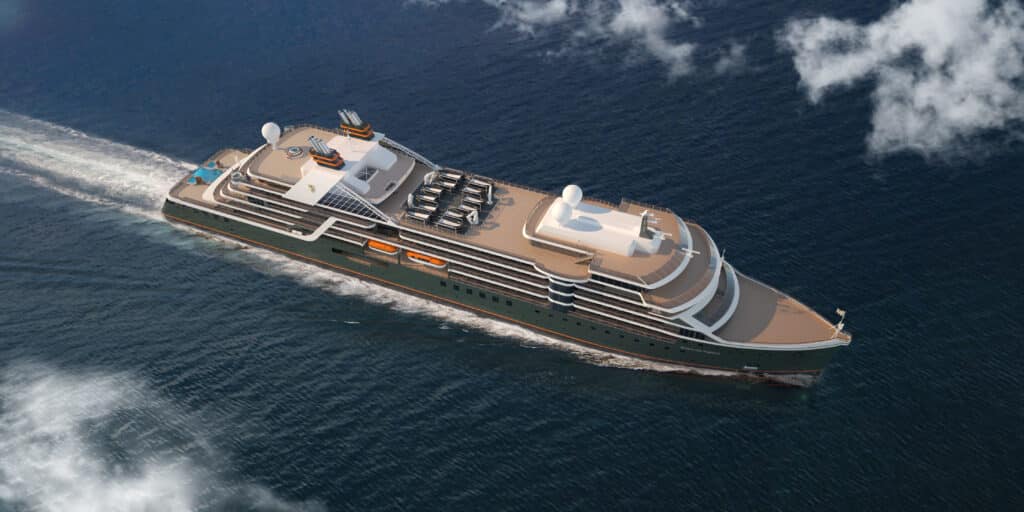
Construction for Seabourn Pursuit began in fall 2020 during a ceremony in San Giorgo di Nogare, Italy, and the build process is well underway. The ship is scheduled for delivery in 2023, with its sister ship, Seabourn Venture, slated for delivery in 2022.
Seabourn Pursuit is the second Seabourn expedition ship slated to launch in 2023. Both Seabourn Pursuit and sister ship Seabourn Venture are designed and built for diverse environments to PC6 Polar Class standards and include modern hardware and technology that will extend the ships’ global deployment and capabilities. Each will carry two custom-built submarines, 24 Zodiacs, kayaks, and a 26-person expert expedition team whose role is to engage guests throughout each voyage.
The ship then continues onward by exploring the waters and landscapes of Greenland, Iceland and Norway throughout the spring and early summer, in some instances retracing the path of the Vikings to the frontier town of Tromsø while carving its way through the inside passage of the Norwegian fjords along the way.



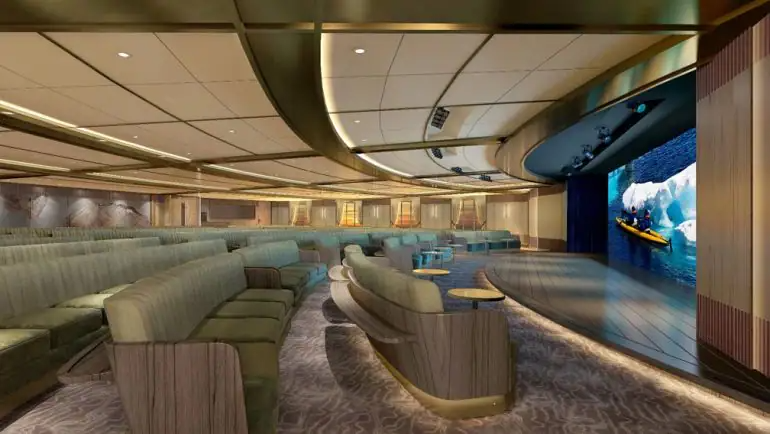
Description
Construction for Seabourn Pursuit began in fall 2020 during a ceremony in San Giorgo di Nogare, Italy, and the build process is well underway. The ship is scheduled for delivery in 2023, with its sister ship, Seabourn Venture, slated for delivery in 2022.
Seabourn Pursuit is the second Seabourn expedition ship slated to launch in 2023. Both Seabourn Pursuit and sister ship Seabourn Venture are designed and built for diverse environments to PC6 Polar Class standards and include modern hardware and technology that will extend the ships’ global deployment and capabilities. Each will carry two custom-built submarines, 24 Zodiacs, kayaks, and a 26-person expert expedition team whose role is to engage guests throughout each voyage.
The ship then continues onward by exploring the waters and landscapes of Greenland, Iceland and Norway throughout the spring and early summer, in some instances retracing the path of the Vikings to the frontier town of Tromsø while carving its way through the inside passage of the Norwegian fjords along the way.
STATEROOMS

suite